 Posts RSS
 Subscribe via Email
DHS is Looking for a CISO
Posted November 4th, 2011 by rybolov
Posted in FISMA, NIST, Odds-n-Sods |  1 Comment »
Tags: compliance • government • infosec • itsatrap • job • NIST • risk • security

Posted in FISMA, NIST, Odds-n-Sods | 1 Comment »
Tags: compliance • government • infosec • itsatrap • job • NIST • risk • security
Go have a look at what Mike Murray and Lee Kushner have to say on what I endearingly refer to as “Stupid Contractor Tricks”.
Now I know Mike and Lee are supposed to be tactful, and they do a really good job at that. This post is not about tact. =)
You need to step back a bit and understand the business model for contractors. Because their margins are low and fixed, it means a couple of things:
So on to my advice in this particular scenario that Mike and Lee discuss: Run away as fast as you can from this offer.
There are a couple of other things that I’m thinking about here:
Other stupid contractor tricks:
Posted in Odds-n-Sods, Rants, What Doesn't Work | 2 Comments »
Tags: cashcows • infosec • itsatrap • management • moneymoneymoney • risk
Just a quick post to shill for Privacy Camp DC 2010 which will be taking place on the 17th of April in downtown DC. I went last year and it was much fun. The conversation ranged from recommendations for a rewrite of
The basic rundown of Privacy Camp is that it’s run like a Barcamp where the attendees are also the organizers and presenters. If you’re tired of going to death-by-powerpoint, this is the place for you. And it’s not just for government-types, there is a wide representation from non-profits and regular old commercial companies.
Anyway, what are you waiting for? Go sign up now.
Posted in Odds-n-Sods, Public Policy, The Guerilla CISO | 1 Comment »
Tags: government • infosec • infosharing • law • legislation • management • privacy • publicpolicy • security
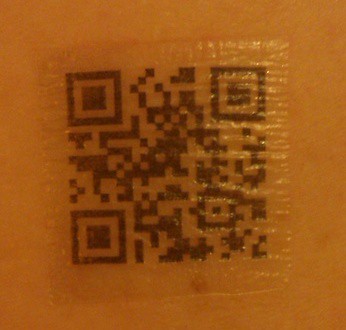
So it started with an idea. How cool would it be to get everybody to install a QR code reader and read temporary tattoos off each other? Anyway, at Shmoocon I walked around with a bag of QR temporary tattoos much to the delight and chagrin of the hackers assembled therein.
The howto:
#1 Get a barcode generator. I use zint, it’s my favorite tool for generation. For those of you on Ubuntu or Debian, I have packages built for you. And give the zint guys some money while you’re at it, they use the funds to buy standards and make zint work with every symbology known to mankind.
#2 Get a layout program. I use Inkscape. Key here is that it has to be able to import .svg files and be able to flip images horizontally.
#3 Get printable temporary tattoo paper. It’s not really cheap, but I found kits on tattoofun.com. The kit consists of waterslide temporary tattoo paper, adhesive sheets, and an instruction sheet.
#4 Make .svg Barcodes! I load up zint and toss some text at it, then use the QR symbology. Some examples:
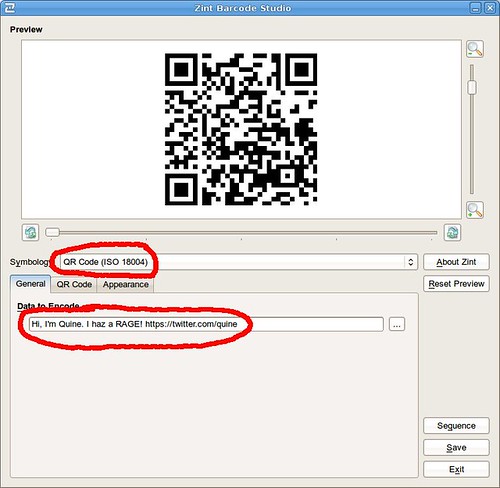
#4.5 Add in QR error correction. The more error correction you use, the more data in the barcode so the smaller the blocks are. However, some error correction compensates for distortion and glare. IIUC, Zint automagically adds in 20% error correction. I’m not sure what the magic number here is because it depends on the size of the printed barcodes.

#5 Export barcode from zint. SVG is awesome to save as because you can scale the barcodes up as much as you want and they won’t get all pixelated-looking. You can grab a ton of the barcodes I made here.
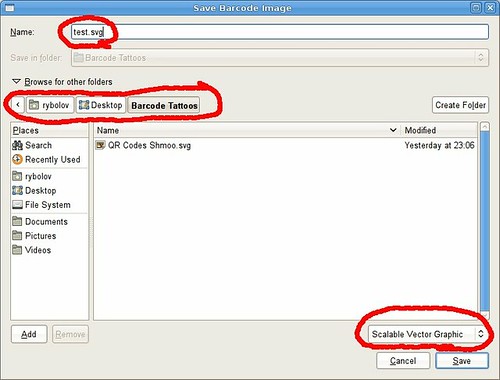
#6 Import barcode into inkscape. File=>Import then select the .svg file you want. Since the barcodes are svg, you can scale them awesomely. For mine, I set up guidelines so I could lay out rows proportionately. Be sure to lock the object proportions or you’ll get hideously warped QR monstrosities that nothing can read. You can grab my sheet of barcodes here.

#7 Make “The Big Flip” and print. Inkscape-specific: Edit=>Select All followed by Object=>Flip Horizontal. Then print the page on the glossy side of the slide water paper.
#8 Add the sticky. It’s a bit like laminating a map only the adhesive is way more forgiving. Poke some pin-holes in the adhesive sheet and smooth out all the bubbles.
#9 Cut, peel, stick, wet, pull, read, lol. You can get a reader here, but the important bits: iTunes Store: Barcodes. Android: Barcode Scanner.
Lessons Learned:
Laser barcode scanners don’t work because the film is reflective. Photo-based barcode scanners (ie, most mobile scanners) work pretty well.
You have to make the barcodes bigger than I did. Mine were .75x.75 inches and due to the glare on the paper and some distortion due to putting them on skin, they were hard to read. I think maybe 2×2 inches are optimum.
Hackers don’t like informational urls in their tattoos: “I got an add for ZXing, this sucks”. I think random goofy phrases and skin pwnage would work better than informational urls.
Some people (Quine) weren’t happy with a grab-bag random url and needed their own custom witty saying. I felt the rage, it has now been fixed.
You can’t read the barcodes until they’re on the skin because of the horizontal flip. Before you do the flip, print out the barcodes on regular paper. You can read these easily enough. Then flip the finished barcode sheet over after you’ve printed it and you can match up the barcode with the non-flipped sheet. Even better if you use your computer monitor as a lightbox.
Posted in Hack the Planet, Odds-n-Sods, Technical | 6 Comments »
Tags: barcode • hacking
I’m curtailing my blog for a couple of weeks. I’m busy helping out with Haiti.
I spent last Saturday at CrisisCamp DC. It’s a barcamp-style hackathon to build applications to help relief workers in Haiti. Think long-range wifi routers to network the country where the infrastructure is destroyed. Think a website for quake survivors to tell their story. Think a Craiglist for relief workers where somebody with an oxygen generator and somebody with a power supply can get together and make something that helps both of them. Think all of these created in an 8-hour development stint.
Yes, security folks, you can help. Not only that, but you have the technical skills to get web apps stuff done and the project management experience to lay out what it is that needs to be done.
We’re holding another CrisisCamp in DC this Saturday the 30th.
Go to crisiscommons.org and look for a project that interests you or a local camp.
Here, let Andy Carvin break it all down “Big Bird Style”:
Movie by @Digiphile, Alex Howard from SearchCompliance.com. Hopefully I didn’t just “out” him. =)
Posted in Hack the Planet, Odds-n-Sods, Technical, What Works | 1 Comment »
Tags: crisiscommons
So I’m working with the AppSecDC folks doing press relations amongst other things. I’ve noticed several themes for the conference that might be of interest to the rest of the world. Of course there’s the usual “The end is nigh, and not even Norton can save you!!!!!” stuff that’s been the staple of security conferences for the past 5 years or so (oh noes, teh Internetz are broken. Again)
However, AppSecDC has another set of themes that are mostly unique to OWASP and AppSecDC in particular:
Convinced you want to go? Check out the conference site.
Posted in Odds-n-Sods, What Works | 1 Comment »
Tags: government • infosec • management • owasp • security